• retagged by
2,255 views
1 1 vote

Two trains $\text{A}$ and $\text{B}$ were moving in opposite directions, their speeds being in the ratio $5:3.$ The front end of $\text{A}$ crossed the rear end of $\text{B} \; 46 \; \text{seconds}$ after the front ends of the trains had crossed each other. It took another $69 \; \text{seconds}$ for the rear ends of the trains to cross each other. The ratio of length of train $\text{A}$ to that of train $\text{B}$ is

  1. $2:3$
  2. $2:1$
  3. $3:2$
  4. $5:3$

1 Answer

1 1 vote

Let the length of train $\text{A}$ be $x \; \text{m},$ and the length of train $\text{B}$ be $y \; \text{m}.$

Let the speed of train $\text{A}$ be $5s \; \text{m/sec},$ and the speed of train $\text{B}$ be $3s \; \text{m/sec}.$

Let’s draw the diagram for a better understanding.
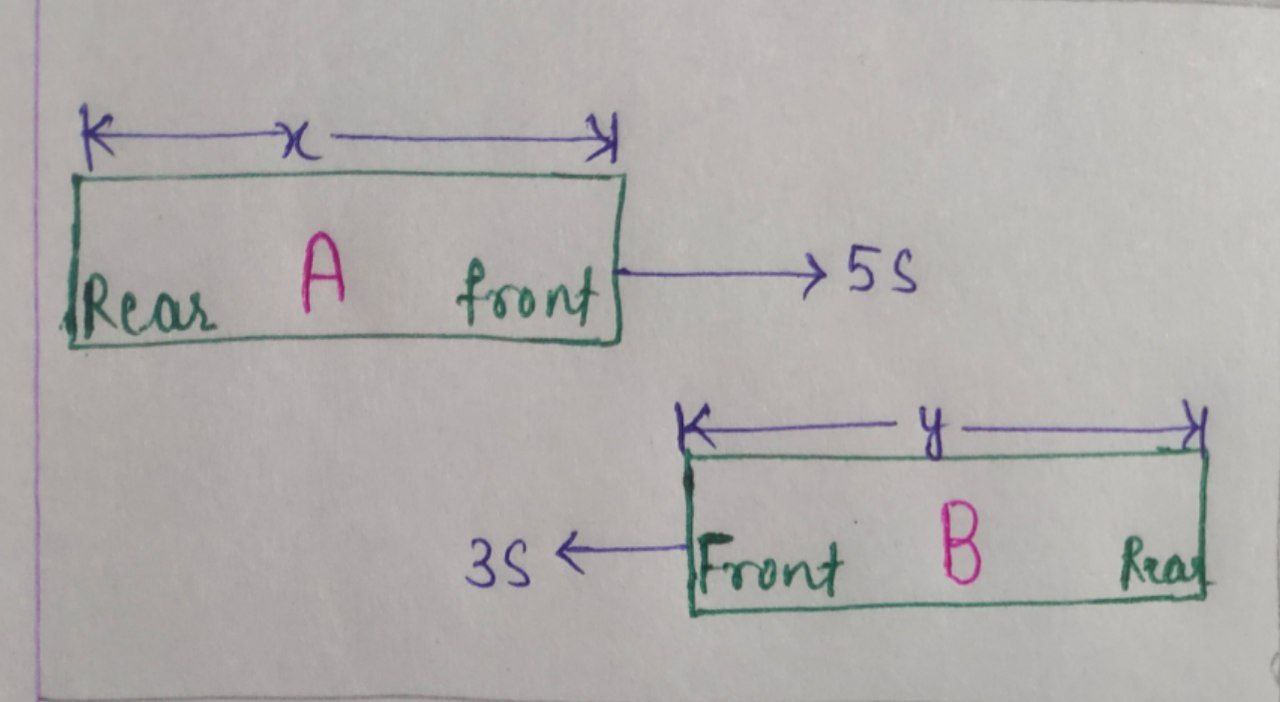

The front end of $\text{A}$ crossed the rear end of $\text{B 46}$ seconds after the front ends of the trains had crossed each other.
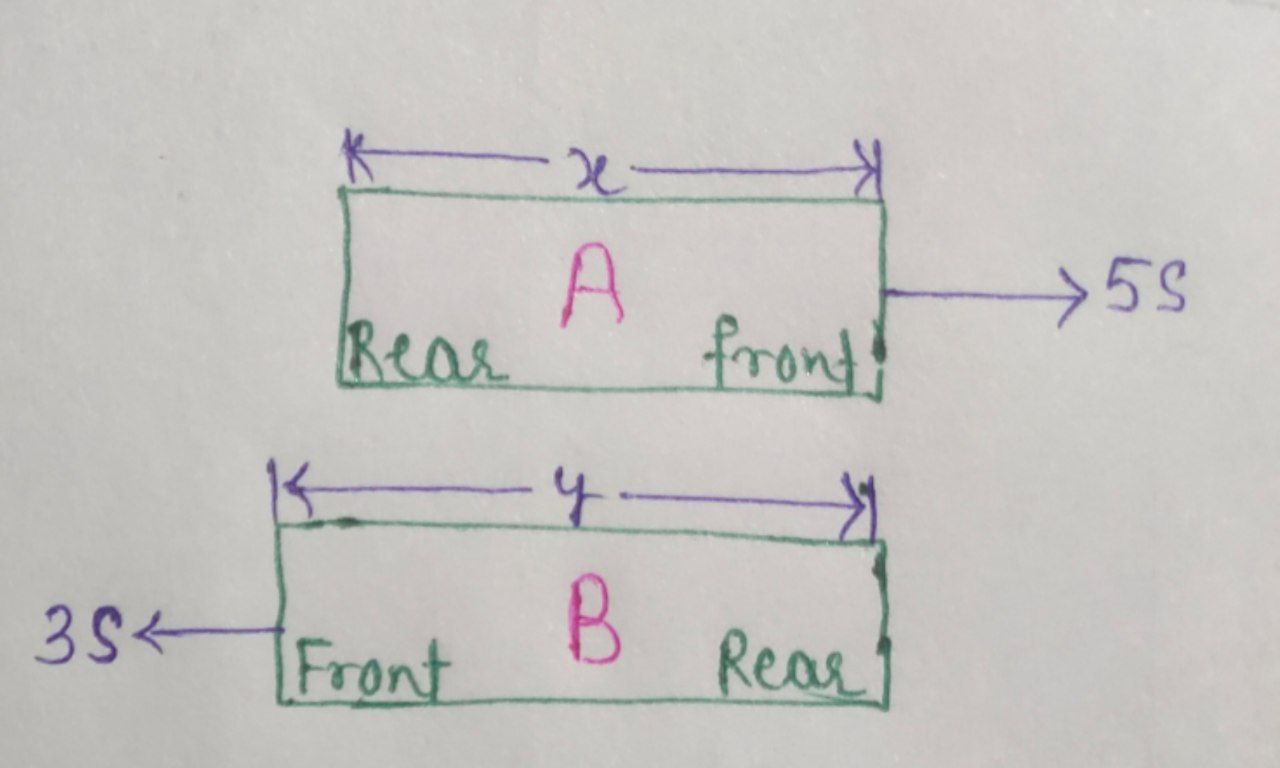


Here, $ y = 46 \times 8s \quad \longrightarrow (1)$

 It took another $69$ seconds for the rear ends of the trains to cross each other.
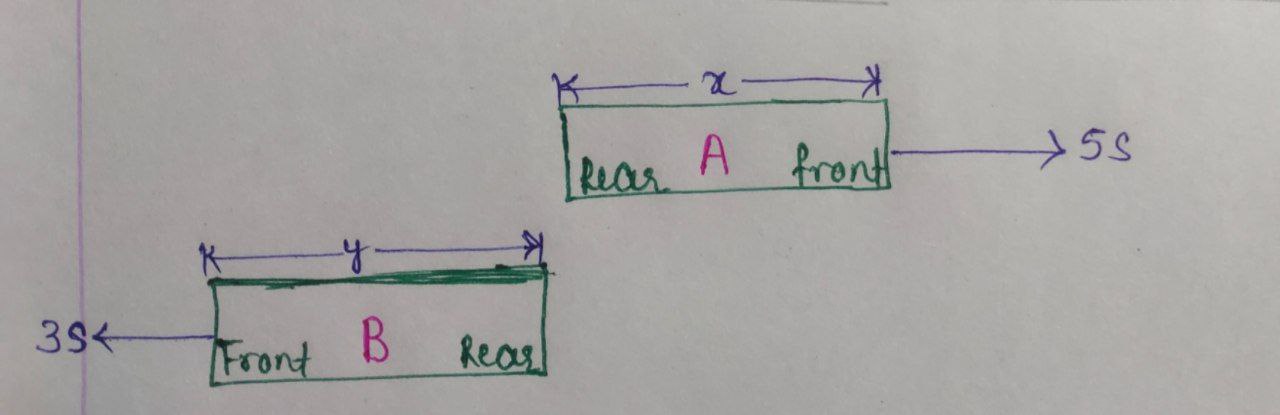


Here, $ x = 69 \times 8s \quad \longrightarrow (2)$
 
Divide equation $(2)$ by equation $(1).$

$\Rightarrow \frac{x}{y} = \frac{ 69 \times 8s}{46 \times 8s}$

$ \Rightarrow \frac{x}{y} = \frac{3}{2}$

$\therefore$ The ratio of length of train $\text{A}$ to that of train $\text{B} = x : y = 3 : 2.$

Correct Answer $: \text{C}$


$\textbf{PS:}\;\text{Important points:}$

  • When two trains are going in the same direction, then their relative speed is the difference between the two speeds.
  • When two trains are moving in the opposite direction, then their relative speed is the sum of the two speeds.
  • When a train crosses a stationary man/ pole/ lamp post/ sign post- in all these cases, the object which the train crosses is stationary, and the distance traveled is the length of the train.
  • When it crosses a platform/ bridge- in these cases, the object which the train crosses are stationary and the distance traveled is the length of the train and the length of the object.
  • When two trains are moving in the same direction, then their speed will be subtracted.
  • When two trains are moving in opposite directions, then their speed will be added.
  • In both the above cases, the total distance is the sum of the length of both the trains.
• edited by
Position:
Show:
Answer:

Related questions

1 1 vote
1 1 answer
1.8k
1.8k views
soujanyareddy13 asked Jan 20, 2022
1,829 views
Consider the pair of equations: $x^{2} – xy – x = 22$ and $y^{2} – xy + y = 34.$ If $x>y,$ then $x – y$ equals$7$$8$$6$$4$
1 1 vote
1 1 answer
2.2k
2.2k views
soujanyareddy13 asked Jan 20, 2022
2,171 views
If a rhombus has area $12 \; \text{sq cm}$ and side length $5 \; \text{cm},$ then the length, $\text{in cm},$ of its longer diagonal is$\sqrt{13} + \sqrt{12}$$\sqrt{37} +...
2 2 votes
1 answers 1 answer
3.5k
3.5k views
soujanyareddy13 asked Jan 20, 2022
3,510 views
The number of ways of distributing $15$ identical balloons, $6$ identical pencils and $3$ identical erasers among $3$ children, such that each child gets at least four ba...
1 1 vote
1 1 answer
2.0k
2.0k views
soujanyareddy13 asked Jan 20, 2022
2,049 views
For a sequence of real numbers $x_{1}, x_{2}, \dots , x_{n},$ if $x_{1} – x_{2} + x_{3} – \dots + (-1)^{n+1} x_{n} = n^{2} + 2n$ for all natural numbers $n,$ then the sum...
1 1 vote
1 1 answer
2.2k
2.2k views
soujanyareddy13 asked Jan 20, 2022
2,223 views
For a real number $x$ the condition $|3x – 20| + |3x – 40| = 20$ necessarily holds if$9 < x < 14$$6 < x < 11$$7 < x < 12$$10 < x < 15$