retagged by
1,849 views
1 1 vote

From an interior point of an equilateral triangle, perpendiculars are drawn on all three sides. The sum of the lengths of the three perpendiculars is $s.$ Then the area of the triangle is 

  1. $\frac{\sqrt{3}s^{2}}{2}$
  2. $\frac{s^{2}}{\sqrt{3}}$
  3. $\frac{2s^{2}}{\sqrt{3}}$
  4. $\frac{s^{2}}{2 \sqrt{3}}$

1 Answer

1 1 vote

Let the side of the equilateral triangle be $x.$

Let us consider an equilateral $\triangle \text{ABC, I}$ be interior point such that, $\text{ID, IE,}$ and $\text{IF}$ are perpendicular to sides $\text{BC,  AC,}$ and $\text{AB}$ respectively.
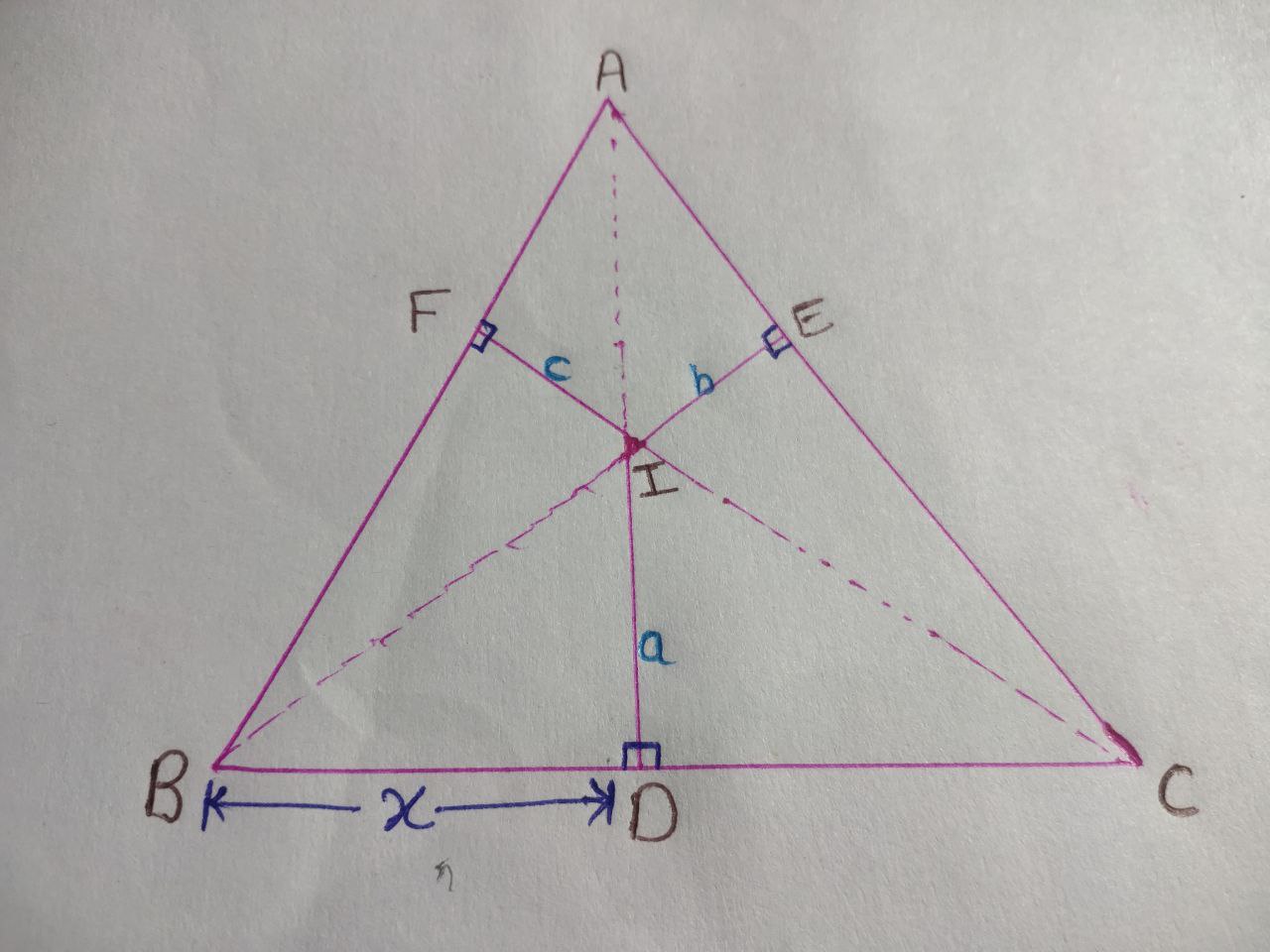


And, let $ \text{ID}= a, \text{IE}= b, \text{IF}= c.$

Also, $a+b+c = c$

Now, $ \text{Area of ABC} = \text{area of} \; \triangle \text{AIC} + \text{area of} \; \triangle \text{BIC} + \text{area of} \; \triangle \text{AIB}.$

$ \qquad \qquad = \frac{1}{2} \times x \times b + \frac{1}{2} \times x \times a + \frac{1}{2} \times x \times c $

$\qquad \qquad = \frac{1}{2} \times x (a+b+c) \; [\because a+b+c = s]$

$\qquad \qquad = \dfrac{xs}{2} \quad \longrightarrow (1)$

We know that, area of equilateral triangle $ = \dfrac{\sqrt{3}}{4} \times \text{(side)}^{2}$

Now, $ \dfrac{\sqrt{3}}{4} \times x^{2} = \dfrac{xs}{2} \quad [\because \text{From equation (1)}]$

$ \Rightarrow \boxed{ x = \frac{2s}{\sqrt{3}}}$

$\therefore$ The area of an equilateral triangle $ = \dfrac{\sqrt{3}}{4} \times x^{2}$

$\qquad \qquad = \dfrac{\sqrt{3}}{4} \times \left( \dfrac{2s}{\sqrt{3}} \right)^{2}$

$\qquad \qquad = \dfrac{\sqrt{3}}{4} \times \dfrac{2s}{\sqrt{3}} \times \dfrac{2s}{\sqrt{3}}$

$\qquad \qquad = \dfrac{s^{2}}{\sqrt{3}} \; \text{unit}^{2}.$

Correct Answer $: \text{B}$

edited by
Position:
Show:
Answer:

Related questions

2 2 votes
1 1 answer
1.9k
1.9k views
soujanyareddy13 asked Sep 17, 2021
1,921 views
​​​​​​​​​​​​​​​​​​​​​​​​​​​​The sum of the perimeters of an equilateral triangle and a rectangle is $90 \; \text{cm}.$ The area, $\text{T},$ of the triangle and the area,...
2 2 votes
1 1 answer
2.0k
2.0k views
soujanyareddy13 asked Sep 17, 2021
2,046 views
Let $\text{C}$ be a circle of radius $5 \; \text{meters}$ having center at $\text{O}.$ Let $\text{PQ}$ be a chord of $\text{C}$ that passes through points $\text{A}$ and ...
2 2 votes
1 1 answer
1.9k
1.9k views
soujanyareddy13 asked Sep 17, 2021
1,872 views
Let $\text{C}1$ and $\text{C}2$ be concentric circles such that the diameter of $\text{C}1$ is $2 \; \text{cm}$ longer than that of $\text{C}2.$ If a chord of $\text{C}1$...
2 2 votes
1 1 answer
1.9k
1.9k views
soujanyareddy13 asked Sep 17, 2021
1,889 views
In a car race, car $\text{A}$ beats car $\text{B}$ by $45 \; \text{km},$ car $\text{B}$ beats car $\text{C}$ by $50 \; \text{km},$ and car $\text{A}$ beats car $\text{C}$...
1 1 vote
1 1 answer
2.7k
2.7k views
soujanyareddy13 asked Sep 17, 2021
2,682 views
John takes twice as much time as Jack to finish a job. Jack and Jim together take one-thirds of the time to finish the job than John takes working alone. Moreover, in ord...