edited by
8,708 views
5 5 votes

Direction for the question given below

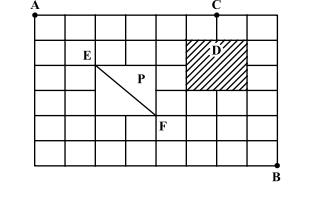
The figure below shows the plan of a town. The streets are at right angles to each other. A rectangular park $\text{(P)}$ is situated inside the town with a diagonal road running through it. There is also a prohibited region $\text{(D)}$ in the town

Neelam resides her bicycle from her house at $\text{A}$ to her office at $\text{B}$, taking the shortest path, then the number of possible shortest paths that she can choose is

  1. $60$
  2. $75$
  3. $45$
  4. $90$
  5. $72$

2 Answers

2 2 votes

90

We can find the number of shortest possible paths from A to E either by trial and error or by using combinations. Note that to travel from A to E, we have to take 2 roads to the right and 2 roads downwards (in the diagram) in order that we follow the shortest path. In other words, we have to use 2 + 2 = 4 roads, out of which 2 are towards right and 2 are downwards. This is equivalent to selecting 2 things (roads towards right) out of 4 things (roads). (The remaining two roads will be downwards.) The number of ways of doing this is 4C2 = 4!/(2!×2!) = 6 From point A to E, there are 6 ways to reach with the minimum distance travelled. Here E to F is the shortest distance because the third side of a triangle is always less than the sum of the other two sides.

From point F to B, there are 6C4 = 6!/(4!×2!) = 15 ways to reach with the minimum distance travelled. There are 15 × 6 = 90 shortest paths that Neelam can choose

2 2 votes

The answer provided in the previous post is right but the explanation is incorrect.

The shortest path will be A → E → F→ B. Because the entire map is symmetric but the diagonal creates a new shorter path from E→ F. Diagonal is shorter than the sum of its perpendicular and base (Pythagoras Theorem’s Corollary).

Now to go from A to E, we have to travel right two times and travel downwards two times. So, we could for example, take R, D, R and D or we could take R, R, D, D. So how many such arrangements are possible ?? Lets list them down :-

R R D D, D D R R, R D R D, D R D R, R D D R, D R R D – Six arrangements possible

So the questions is how many permutations/arrangements of these four roads (R R D D) is possible given two of them are repeating twice.

It is : $\large \frac{^{4} P_{4}}{2!*2!} = \frac{4!}{2! * 2!} = 6$

Similarly, for F to B, we have to take four rights and two downs (R R R R D D). So the number of arrangements of these six roads, one which repeats twice and the other repeats four times is :

 $\large \frac{^{6} P_{6}}{4!*2!} = \frac{6!}{4! * 2!} = 15$

Therefore, the total number of ways are :  $\large 6 *15 = 90$.

Related questions

0 0 votes
0 0 answers
1.3k
1.3k views
go_editor asked Apr 30, 2016
1,259 views
Direction for the below question:Mark $(1)$ if Q can be answered form A alone but not from B alone.Mark $(2)$ if Q can be answered form B alone but not from A alone.Mark ...
0 0 votes
0 0 answers
1.6k
1.6k views
go_editor asked Apr 30, 2016
1,561 views
Directions for below question:Five horses, Red, White, Grey, Black and Spotted participated in a race, As per the rules of the race, the persons betting on the winning ho...
0 0 votes
1 answers 1 answer
4.2k
4.2k views
go_editor asked Apr 28, 2016
4,225 views
Direction for the question given belowThe figure below shows the plan of a town. The streets are at right angles to each other. A rectangular park $\text{(P)}$ is situate...
0 0 votes
0 0 answers
1.3k
1.3k views
go_editor asked Apr 28, 2016
1,251 views
Answer the following question based on the information given below.Abdul and Bikram and Chetan are three professional traders who trade in shares of a company $\text{XYZ}...
0 0 votes
0 0 answers
1.4k
1.4k views
go_editor asked Apr 28, 2016
1,411 views
Answer the following question based on the information given below.Abdul and Bikram and Chetan are three professional traders who trade in shares of a company $\text{XYZ}...